Transform Your Bible Reading: 3 Tips (continued)
This month we are wrapping up our series on tips for better Bible reading. As a reminder, Tips 1 and 2 are:
Tip 1: Don’t Just Read—Listen Too!
Tip 2: Read Your Bible without the Chapters and Verses
Tip 1 helps us appreciate the majesty, artistry, and literary nature of the Bible. When we listen to the Bible, we hear and process its words differently than when we simply read them on the page.
Tip 2 helps remove another distraction by teaching us to look past all the numbers on the page. Instead of treating the Bible as a collection of isolated sayings and verses because of all the chapter and verse numbers, we can read it as a cohesive piece of writing just as we would read a letter from a friend or a book off the shelf.
Now we come to the last of our tips for better Bible reading.
Tip 3: Read Entire Books or Sections in One Sitting
I saved this tip for last because it is probably the most intimidating, and frankly, the hardest for most of us to implement. It requires commitment, resolve, and patience. In all likelihood, you will fall short of your goal a time or two, especially as you work your way toward some of the longer books of the Bible. But just as you wouldn’t stop eating altogether because you missed a meal or two, you shouldn’t give up on reading your Bible in deeper and better ways simply because you didn’t reach your goal. Try and try again.
Read Big and Read Small
As the title of this tip suggests, we should endeavor to read entire books of the Bible in one sitting (or at least extended sections of the longer books).
There is great value in following a Bible reading plan that guides you through a few chapters each day. In fact, this is my primary method of Bible reading. But if that is the only way we read the Bible, we can still end up reading Scripture in fragments. The longer the sections of Scripture that we read at one time (or at least in quick succession), the more likely we are to understand the overall story and recognize connections within it.
We need both macro-reading and micro-reading. We need to read big, and we need to read small.
We read smaller portions of Scripture so that we can slow down, study, and see the details. We read larger portions so that we can see the overall story, make connections, and place those details in their broader context. Both are important if we want to understand the Bible well.
Start with Short Books
I know the objection that is probably forming in your mind right now because it is the same one that occurs to me: “Preacher, reading through an entire book like Genesis or Revelation would take me at least a couple of hours. There is no way I have time to do that.” That would be a fair objection except for two things.
First, we don’t have to start with the longest books. Start with the shorter ones.
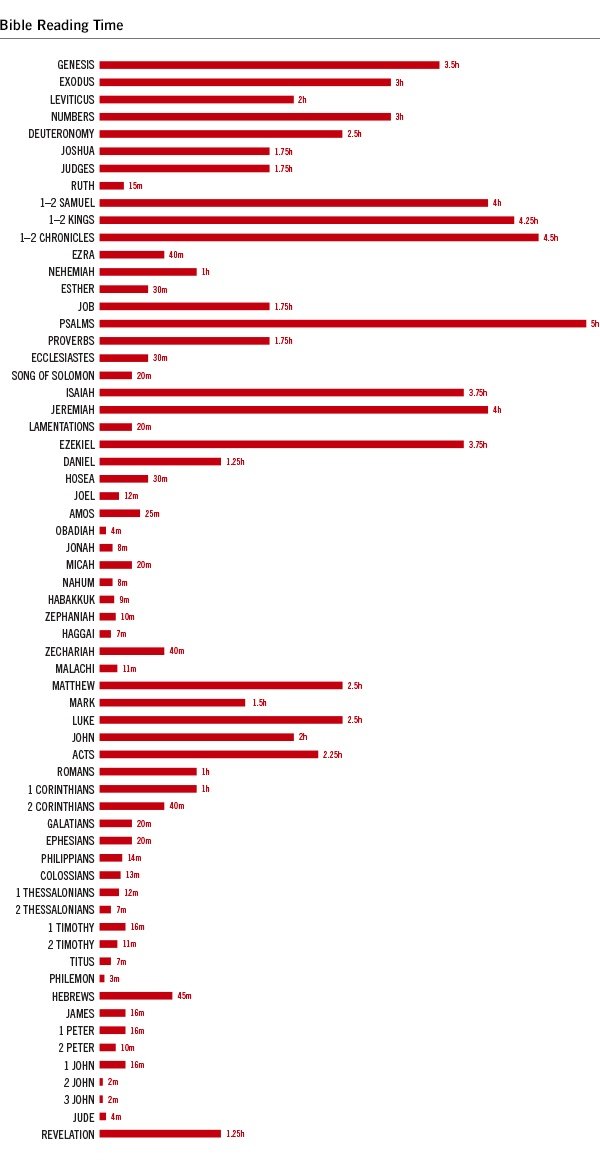
For instance, Jude takes the typical reader only about four minutes to read. Philemon, 2 John, and 3 John each take less than five minutes. From there, you can work your way up to books like Philippians, Colossians, 1 and 2 Thessalonians, 1 and 2 Timothy, Titus, James, 1 and 2 Peter, and 1 John. All of these can be read in roughly fifteen minutes or less. Just by reading those books, you will have read more than half of the books of the New Testament in their entirety.
If you are interested, you can consult this chart from Desiring God for approximate reading times for each book of the Bible.
Redeem the Time
Second, we already spend extended periods of time doing other things every week, don’t we?
We might watch a football or baseball game for three hours. We can easily spend thirty minutes scrolling through Facebook, Instagram, or TikTok. Perhaps we sit down to watch a two-hour movie on Friday or Saturday night. If we’re being honest, we already spend extended periods of time doing something.
What if, once or twice a month, we redeemed some of that leisure time by giving it to undistracted engagement with the life-giving Word of God? I am not suggesting that you replace all of your leisure or rest with Bible reading. Rest is good. Entertainment can even be a way of appreciating the beauty, complexity, and wonder of God’s world. But most of us could take one or two of those extended periods each month and devote them to reading an entire book of the Bible.
At the end of the day, all of us need to find ways to give ourselves to reading the Bible as faithfully and fruitfully as we can. My hope is that these three tips will encourage and challenge you to read Scripture regularly, to read it carefully, and sometimes to read a lot of it at once.
Take in the Bible like you breathe air or eat food. Listen to it. Read it like a book. Read small portions carefully and big portions broadly.
Above all, give yourself to the Word of God so that you might better know the God who has spoken to us through it and find truth to live by.
NOTE: I first learned these tips from Andy Naselli: http://www.desiringgod.org/articles/three-tips-for-better-bible-reading.